Skip to main content Skip to footer

Notice: We’re performing scheduled updates to our Laserfiche system on Friday, June 5, 2026. During this time, Laserfiche services will be temporarily unavailable. We appreciate your patience and encourage you to check back on Monday when access is restored. If you need immediate assistance, please contact us at [email protected].

Collection System Master Plan

City of Meridian 2023 Collection System Master Plan Update Executive Summary

The last comprehensive Collection System Master Plan for the City of Meridian was completed in 2017. The City continues to experience significant growth and numerous minor modifications have been made to the 2017 Master Plan to accommodate that growth. The City authorized J-U-B ENGINEERS, Inc. to undertake a comprehensive update of the Collection System Master Plan, with following major goals:

  • Consolidate all modifications to the previous master plan and update the conceptual layout of trunk lines 10-inches and larger.
  • Recalibrate the hydraulic model and update unit flows.
  • Update specific area plans included in the master plan, including the Northwest Sewer Phasing, Southwest Phasing Plan and Downtown Sewer Replacement Plan.
  • Establish a comprehensive Capital Improvement Plan (CIP) with particular emphasis on the next
    5 to 10 years.

The sections below provide a brief summary of each component of the 2023 Collection System Master Plan Update and the associated results.

The City of Meridian system is comprised of over 520 miles of gravity sewer, 9 miles of pressure sewer, 11 lift stations and 10 diversions. The City maintains and utilizes a robust sewer GIS dataset for maintenance and operations, planning, asset management, project concept development, and hydraulic modeling. The City is currently updating their asset management program to move from an inspection based approach to a more proactive approach.

The Existing Model utilizes water meter usage data provided by the City to establish existing flows for each parcel connected to the system. The model has been re-calibrated to flow monitoring data collected at several locations in the fall of 2021. See Appendix C for calibration results.

Figures A6 and A7 show the resulting depth over diameter and reserve capacity of the existing collection system during a design storm event. No bottlenecks were identified and no surcharging occurred in the
system. Potential bottlenecks were identified and are described in Appendix E. Model results from the Existing Model scenario are included in Appendix D.

The Committed Model scenario represents everything that the City has committed to serve. This includes parcels annexed into the City and assumes no vacancy in the existing service area. Committed flows from parcels of property that were not already included in the Existing Model were developed using unit flows derived from an analysis the water meter usage data provided by the City. The current average daily flow for a single-family residential unit is 145 gpd (approximately 50.3 gallons per capita). The Committed Model is used to evaluate how the existing system will accommodate future flows the City has already committed to serve. Future capital improvements were not included, which allowed prioritization of capital improvements needed to address collection system capacity.

Figures A10 and A11 show the resulting depth over diameter and reserve capacity of the existing collection system with committed flows during a design storm event. Upgrades will be necessary at the Oaks LS, North Black Cat LS and South Black Cat LS. No other issues were identified during the Committed Model analysis, although several additional potential bottlenecks were identified. Potential bottlenecks were identified and are described in Appendix E. Model results from the Existing Model scenario are included in Appendix D.

The study area is shown in Figure A1. The total area included in the study area is approximately 38,300 acres. The City has experienced significant growth in the past 30 years and COMPASS anticipates growth to continue at a rate of 2.0 percent through 2040. If a 2 percent growth rate is maintained, the study area is projected to build out by the year 2066.

The Master Plan Model shows the results of full build-out of the City’s study boundary encompasses approximately 60 square miles. It also includes location, size, and depth of master planned sewer lines required to provide sewer service to new areas within the wastewater service area. Figures A12 and A13 show the ultimate pipe sizes and approximate depths of master plan lines.

Master plan flows that were not already included in the Committed Model were developed using unit flows derived from the water meter data provided by the City. Future capital improvements were not included, allowing identification of all capital improvements needed to address collection system capacity. Figures A16 and A17 show the resulting depth over diameter and reserve capacity of the existing collection system with master plan flows during a design storm event. The specific depth required for each master plan line, along with the master plan model output, can be found in Appendix D. Potential bottlenecks that do not result in surcharging are described in Appendix E. Upgrades will be necessary at the Oaks LS, North Black Cat LS and South Black Cat LS. Two bottlenecks in the existing collection system
were also identified:

  • Five Mile Trunk – Surcharge of ~15 inches
  • Ten Mile Trunk – Surcharge of ~6 inches

One additional master plan scenario was developed that evaluated development with increased densities (see Section 6.5).

The CIP identifies and describes the improvements necessary to provide service to the study boundary. It also provides an approximate timeline for implementation of these projects. The following guidelines are used to determine the timeframe for CIP projects:

  • Current Project: These projects are presently in various stages of design or construction.
  • 0 to 10 Years: Issues identified in the Existing Model Scenario represent problems that could be realized today if a design event occurred. Also includes rehabilitation/replacement projects and key infrastructure projects.
  • 10 to 20 Years: Issues identified in the Committed Model represent likely problems as currently annexed land (area committed to serve) fully develops. Also includes rehabilitation/replacement projects and key infrastructure projects.
  • As Needed with Growth: Issues identified under the Master Plan Model will not become critical until growth occurs in the corresponding areas. The majority of the CIP falls into this category.

Table ES-1 lists the CIP projects that fall within the 0 to 10 year category. Figure A17 shows the location and type of each project in the CIP. Appendix F contains a project summary and associated cost estimate for each CIP project.

Table ES-1 — CIP Projects (0-10 Years)

CIP Projects (0-10 Years)
ID Project Capital Cost (1)
K.4 McDermott Extension Program $22,746,000
R.1 Yearly Rehabilitation & Replacement $750,000 – $1,500,000 / year
R.2 Oaks LS Phase 2 $100,000
R.3 Oaks LS Phase 3 $100,000
R.4 North McDermott LS Phase 1 $10,410,000
R.7 North Black Cat LS Phase 4 $200,000
LS.5 South McDermott LS $8,754,000

(1) All capital costs are in 2023 dollars and are a Class 4 cost opinion (i.e., -30% to +50% per AACE)

The costs associated with each CIP project were grouped by time and are summarized in Table ES-2. Reference Appendix F for a detailed breakdown of each project and its likely funding source. The funding source may change in the future. The timeframes listed are intended to begin in Fiscal Year 2024. Inclusion in the CIP does not guarantee projects will be funded in the City budget. The CIP costs identified herein should be reviewed and submitted for City Council approval as budget permits. If projects cannot be budgeted for the identified timeframe, they should be budgeted as soon as possible afterwards.

Table ES-2 – CIP Cost Summary

Table ES-2 – CIP Cost Summary
CIP Project Timeframe Capital Cost (1) City Portion Developer Portion
0 - 10 Years $53,560,000 $53,560,000 -
10 - 20 Years $24,928,000 $24,928,000 -
As Needed with Growth $124,562,000 $12,070,000 $112,492,000
Totals $203,050,000 $90,558,000 $112,492,000

(1) All capital costs are in 2023 dollars and are a Class 4 cost opinion (i.e., -30% to +50% per AACE)

Overall, the existing collection system is in good condition and will have adequate capacity to convey current flows through master plan flows as the CIP is implemented. This is evidenced by the relatively few capacity issues within the existing system compared to necessary upgrades to accommodate growth beyond the City’s current service limits.

The hydraulic model used in this analysis was created based on land use and zoning conditions at the time of the study, both of which will change over time. Since the models are based on these parameters, it is critical to keep them updated over time to reflect up-to-date conditions. The Master Plan will therefore require periodic updates to remain a current, accurate, and applicable tool in future evaluations. The City currently plans to update the Collection System Master Plan every five years. Updates may be implemented more frequently if there are significant changes to land use, impact area, collection system, or the rate of development.

Many people were extremely helpful in providing documentation, information, and input throughout the course of this project. We wish, however, to especially thank the City of Meridian Public Works Department staff who contributed to this report including: Warren Stewart, Clint Dolsby, Tyson Glock and Vicki Ly. They were instrumental in collecting data, presenting improvement ideas, evaluating alternatives, expressing system concerns, and giving timely, pointed feedback. This assistance is gratefully acknowledged.

Additional Information

JUB Engineering prepared the City of Meridian 2023 Collection System Master Plan Update.

For more information on the Collection System Master Plan, contact Assistant City Engineer Clint Dolsby.

Phone: 208-898-5500
Email: [email protected]

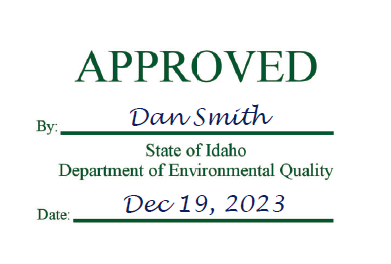
Approved Stamp with a signature of Dan Smith from the State of Idaho Department of Environmental Quality, dated Dec 18, 2023
Stamp: Professional Engineering Chris Webb licensed state of Idaho 15189